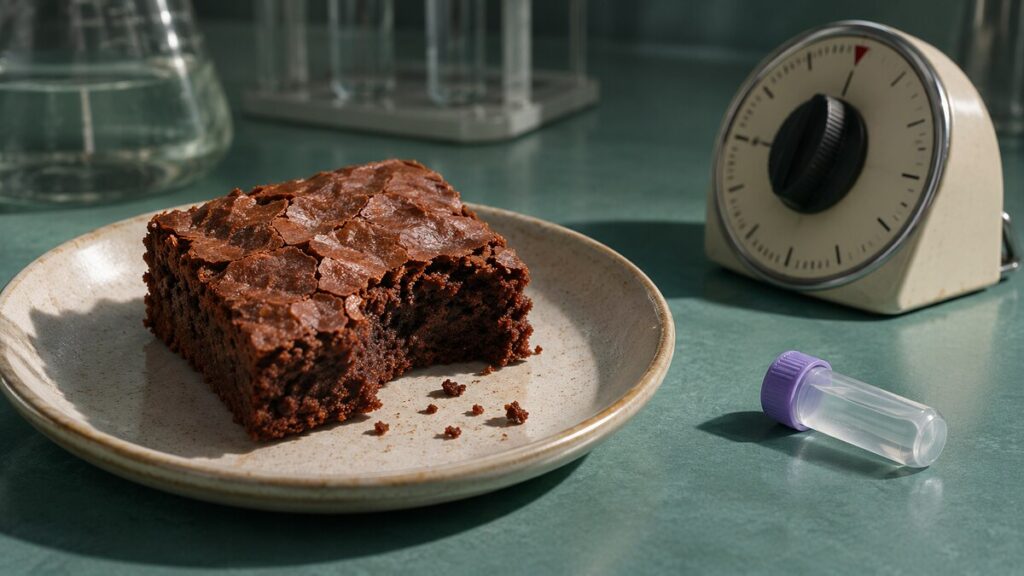
A volunteer finishes a brownie, answers a question about how they feel and provides a sample of oral fluid. The laboratory may already find THC in the sample while the volunteer reports feeling very little. An hour later those two readings can tell quite a different story. The apparent contradiction makes sense once you ask where the sample came from and where the drug has yet to go.
The first measurement can be close to the starting line
Chewing puts food in direct contact with the mouth. A sample collected there soon afterward can contain THC left behind by the brownie. A blood sample comes from farther along the journey. Material swallowed with food must pass through the digestive system, and absorbed THC encounters metabolism in the liver before much of it reaches the general circulation. Inhalation provides a different route from the lungs into the blood. An equal interval on the wall clock can therefore correspond to quite different events inside the body.
In a controlled study of oral cannabis, researchers tracked THC and its metabolites in blood and oral fluid after volunteers consumed brownies. They also asked participants to rate their experiences and complete performance tasks. Subjective and performance effects generally peaked around one and a half to three hours after administration and lasted roughly six to eight hours under the conditions studied. Those figures describe patterns in a small experiment. They do not provide an individual countdown to impairment or recovery.
A sample contains a place as well as a time
Imagine releasing a drop of dye near the bank of a stream. A sample at the release point may be strongly colored before a sample farther downstream shows anything at all. A later measurement at the first point might become paler just as the second becomes darker. The analogy gets one thing right about oral fluid and blood: a concentration always belongs to the place where it was measured. In the body the problem is richer still, because molecules also change identity along the way.
Why the laboratory looks beyond THC
One product of THC metabolism is 11-hydroxy-THC, which itself has psychoactive activity. Another, often abbreviated THC-COOH, is a metabolite useful in studying exposure. These substances have different time courses. A separate controlled examination of cannabis brownies measured the parent compound and metabolites in both blood and oral fluid. Recording them separately helps investigators follow ingestion and metabolism without assuming that one reading captures the entire experience.
Even the phrase “the peak” conceals an experimental choice. Blood draws happen at scheduled intervals. If one draw is higher than the preceding and following draws, it is the highest value observed. The true maximum may have occurred between visits from the phlebotomist. Meanwhile a volunteer may notice changes between two ratings, and a task testing attention may capture a different aspect of the response. Aligning the curves is part of the research, not something an investigator can assume beforehand.
What the brownie cannot stand for
A brownie is useful experimental material because researchers can document what it contains. It is one food among many. A systematic review of oral THC preparations describes variability across formulations and studies. Participants also arrive with different histories of cannabis exposure. A study focused on adults who used cannabis infrequently deliberately defined that population, giving its results a clearer scope than a general statement about all people who eat cannabis products.
The volunteer’s first oral-fluid sample, then, may chiefly tell us that the mouth recently encountered THC. Later blood samples can describe what reached circulation and what metabolites formed. The volunteer supplies a report of the experience that neither tube can give. For an edible, the interesting scientific question is how those three histories fit together. Treating any one of them as the clock for the other two discards much of what the experiment actually discovered.