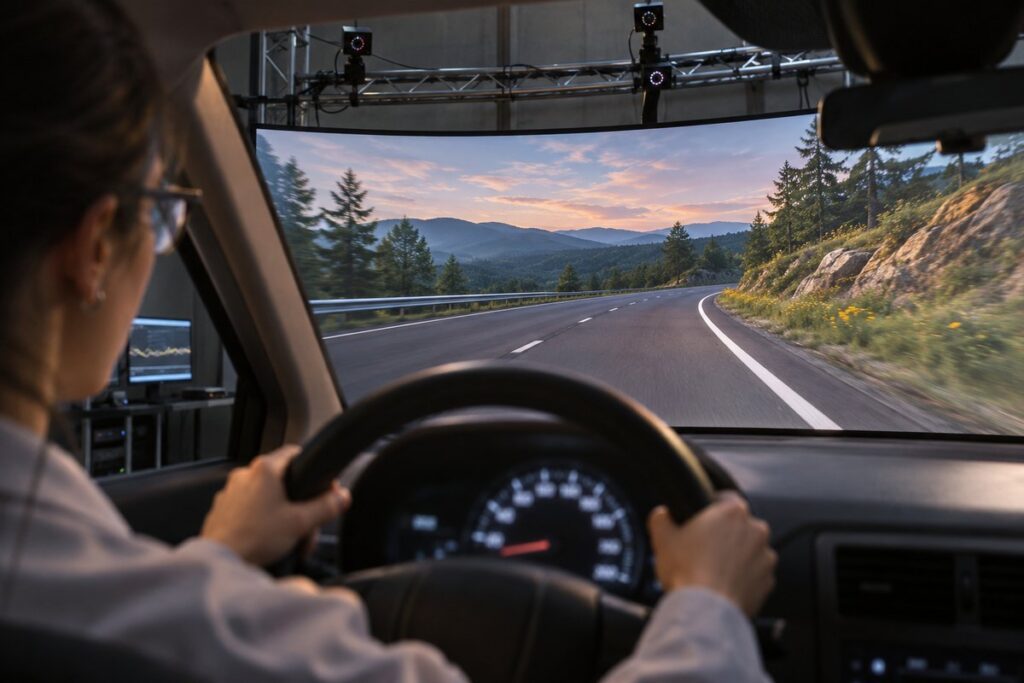
A speedometer is an oddly reassuring instrument. If its needle holds steady, the person in the passenger seat has one reason to think a drive is going well. The painted stripe passing the window can tell another story. A car can travel at a perfectly ordinary speed while edging toward the line and then back toward the shoulder. That distinction matters in experiments asking what happens to driving after someone eats a product containing THC.
In a randomized trial conducted in Toronto, forty adults who regularly used cannabis completed simulator sessions after edibles containing placebo or one of three amounts of THC. The immediate results give an unexpected answer to the question of slowing down. Average speed showed no clear acute effect of dose. Lane control did. A reader looking for a lower speed as the signature of impairment would have missed the main finding.
What the virtual road recorded
Each participant came back for different conditions, so someone’s performance under THC could be compared with their own performance under placebo. The edibles contained zero, two, ten or twenty milligrams of THC. Different participants experienced the conditions in different orders. This arrangement helps separate an effect of treatment from the advantages of simply becoming familiar with the simulator.
The principal measurement was the standard deviation of lateral position. Imagine marking where the center of a car sat across the lane at regular intervals. A tight cluster of marks means the driver held a consistent line. A wider scatter means the car ranged farther from its own average position. It is possible to average a position at the very center of the lane by spending equal time on opposite sides of it. That is why the spread of the marks matters.
There is a limit to the measure, too. Two drivers could both hold a constant line, one near the middle and one uncomfortably close to the edge. Both could register little variation. Investigators choose a measure that is sensitive to a particular change and interpret it alongside other features of the drive. In this study those included speed variability and the time needed to react to a stop signal.
What changed after the edible
The team found evidence of dose-related changes in lateral control during the two- and five-hour assessment period. The ten- and twenty-milligram conditions differed from placebo on the primary outcome. At the highest dose, the increase in lateral-position variability relative to placebo was about 3.3 centimeters. That is a difference in the spread of positions over the course of a drive. It would be misleading to illustrate the result with a car that moved exactly 3.3 centimeters toward the roadside and stayed there.
The speed record had its own detail. Drivers’ speeds varied more at the highest dose, even though average speed was much the same across conditions during the acute tests. A driver who alternates between accelerating and easing off can achieve exactly the same average as one who travels smoothly. In an earlier study of edibles, participants chose how much to consume and drove more slowly at two hours, with no significant change in mean speed at four or six hours. Slowing down can happen. It simply needs to be measured each time.
The view from behind the wheel
Before driving, participants also rated how willing they would be to operate a real vehicle. Those ratings declined with dose. In a separate trial of smoked cannabis and perceived driving safety, researchers compared willingness with performance as effects wore off. The two studies used different routes of administration, so their clocks cannot simply be superimposed.
A separate on-road trial used lateral position during highway drives after vaporized cannabis, extending the same measure beyond the laboratory. A simulator measures performance during the chosen tasks on the chosen schedule. It cannot supply a personal countdown to safe driving or translate the width of a line on a graph straight into crash risk. It does offer something that a glance at a dashboard cannot: a continuous trace of what the car did between one reassuring speed reading and the next.