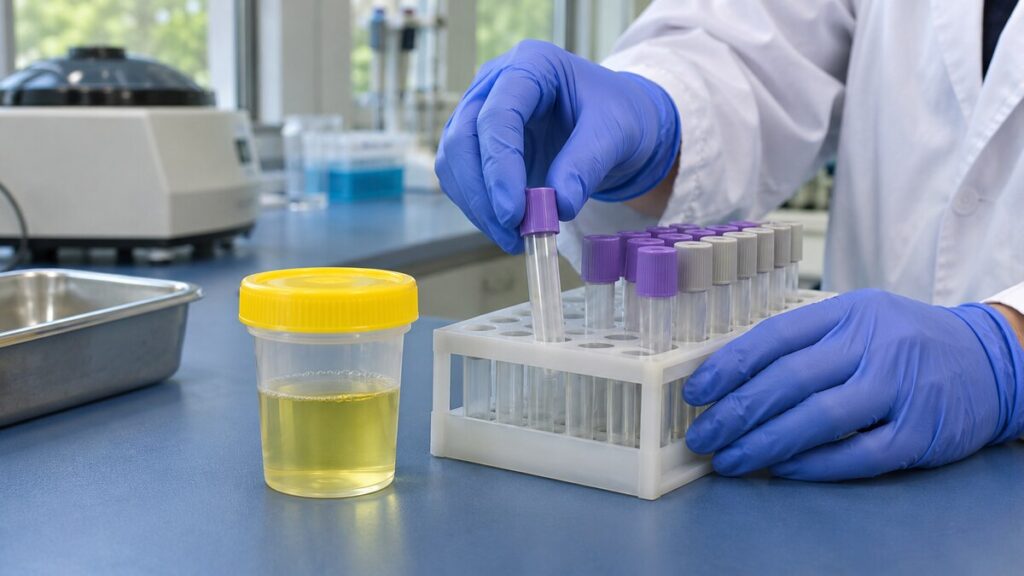
A laboratory result arrives on Tuesday morning. It says that a urine sample contains a metabolite of THC. Someone immediately asks whether the person was impaired during a meeting on Monday afternoon. The sample may be genuine, the chemical identification correct and the paperwork impeccable. The Monday question still asks for information the tube never contained.
What exactly was detected?
The body transforms THC into several compounds. Urine testing commonly looks for a form of THC-COOH, a metabolite that does not itself produce the characteristic intoxication associated with THC. Detecting it supports a conclusion about earlier exposure. The American College of Medical Toxicology’s position statement explains that a positive urine result cannot establish the precise timing, dose, route of exposure or degree of impairment. These are separate uncertainties with a common origin. The test measures an excretion product rather than a person’s behavior at an earlier hour.
It also matters what the laboratory means by “positive.” A screening test can flag a sample for further examination. A confirmatory analysis can identify a particular compound much more specifically. The federal medical review officer’s guidance describes these distinct steps in workplace testing. Confirmation strengthens the claim about chemical identity. Even an exceptionally specific result does not turn a urine concentration into a retrospective attention or coordination test.
Why a timestamp on the cup is not a timestamp on exposure
The collection time records when the sample left the body. Before that, the bladder had accumulated fluid produced over an interval. Meanwhile the liver was processing compounds, and the kidneys were excreting material into a changing volume of urine. Two specimens collected at the same clock time can therefore reflect different physiological histories. There is no simple recipe for taking a single concentration and calculating the hour of use backward.
Consider how easily a ratio can change. Put a fixed quantity of a solute in one cup of fluid and in two cups. Its concentration differs even though the amount of material you started with was identical. Real specimens are more complicated, since both the volume and the quantity excreted can vary. This is one reason scientists pay careful attention to collection conditions when comparing results across samples.
Begin with exposure observed in the laboratory
In research on infrequent cannabis users, investigators collected urine after controlled oral and vaporized administration. They knew the exposures because they had arranged them. The resulting data document which compounds appeared, in what concentrations and in which specimens under the study’s conditions. Running the inference in reverse is much harder. Outside the experiment, the person’s recent history and the characteristics of the consumed product may be unknown.
Another study comparing frequent and occasional users examined urine cannabinoids following several routes of administration. Grouping participants by use history recognizes that a measurement made today can depend on earlier exposures as well as the most recent one. Researchers have also collected samples during continuously monitored abstinence, a design that can trace excretion even when new exposure has been ruled out. An interval observed in volunteers chosen for one use pattern cannot be transferred uncritically to someone with another.
What would answer the Monday question?
To investigate the meeting itself, one would want evidence from the meeting: observations of behavior, the task being attempted, its usual demands and other possible explanations for any difficulty. Sleep loss or illness might also affect performance. Even a well-documented mistake at work does not establish its cause. It does at least describe the phenomenon the original question was about.
Scientific interpretation can end in a modest but durable sentence. The tested sample contained the identified metabolite at or above the threshold used. That result can be meaningful for the purpose that prompted the test. If the next sentence contains a particular afternoon, an amount consumed or a judgment about a person’s performance, look for the additional evidence that supplies it. A collection timestamp and an accurate chemical name cannot do that work on their own.